Two sectors. One methodology.
Backstaff has been validated on a 28-agent reference fleet and reframed in two operating contexts: military analyst auditing and education tutor auditing. Same math, two sectors. The cross-sector demonstration that the substrate is sector-agnostic — and that the instrument names the gap regardless of who is holding it.
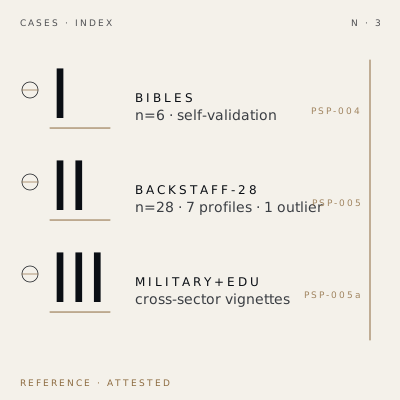
The two case studies.
Military Analyst Fleet
A hypothetical 16th AF cyber unit deploys 28 LLM-augmented threat-intel analysts. Backstaff audits the fleet by what it casts — outputs, behavioral signatures — and returns a bundle a program office can cite in an authorization package. 28 agents → 7 distinct profiles → 21 dedupe candidates → 1 catastrophic outlier at +3.86σ. NIST AI RMF-mapped. IL2-packageable, IL4 on request.
Education Tutor Fleet
A mid-sized district has procured 28 LoRA-tuned tutors over three budget cycles. Backstaff audits the catalog against model weights and a synthetic probe set — no student record is touched. 28 tutors → 7 pedagogically distinct profiles → 21 consolidation candidates → 1 coherence failure at -3.86σ. FERPA-outside-by-construction. State DoE compatible.
What every case study includes.
The cross-sector methodology.
The two case studies are not parallel inventions. They are the same audit, run once on a reference fleet, read twice in sector terms. The cross-sector methodology page walks the math — how distinctness, drift, and coherence are computed once and re-framed for procurement officers in defense and curriculum officers in education without re-running the underlying measurement.
Reference fleets.
These are Astrolabe's internal validation fleets — the math behind Backstaff's audits. They demonstrate the engine works; they are not customer-facing case studies. Read them when you want to see the unanonymized numbers underneath the sector vignettes above.
Verify any bundle.
Every bundle on this site can be recomputed byte-for-byte against its sha-pinned, Merkle-rooted manifest. The verification tool runs on customer infrastructure and does not call home. If the root in the bundle does not equal the root you recompute, the bundle is not the one we published.